
04 Smaller companies
The Best Things Come in Small Packages
Smaller companies have fallen out of favour, and now look some of the best value in today’s markets.
5 min read · Portfolio Thinking Annual Outlook 2027
Key takeaway 1
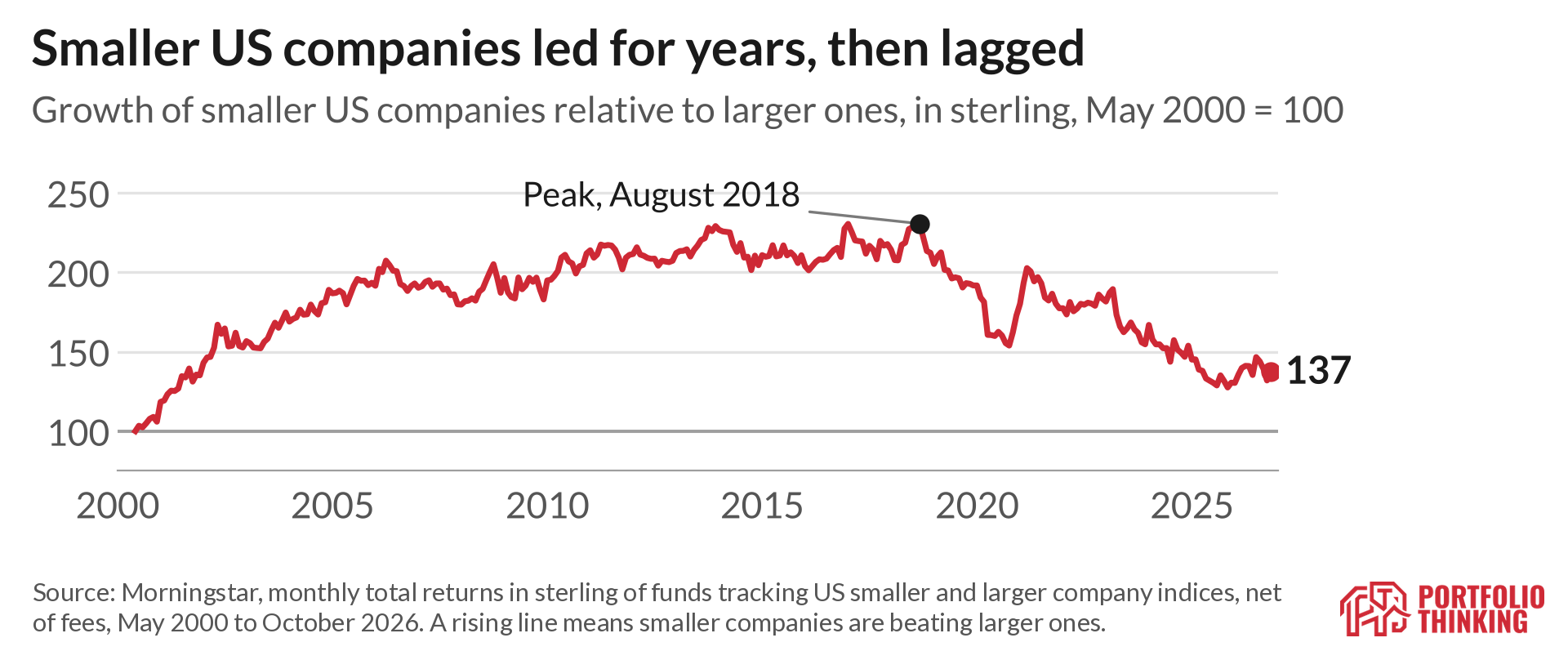
Smaller companies have beaten larger ones by about 3% a year over the long run, but have lagged over the past decade.
Key takeaway 2
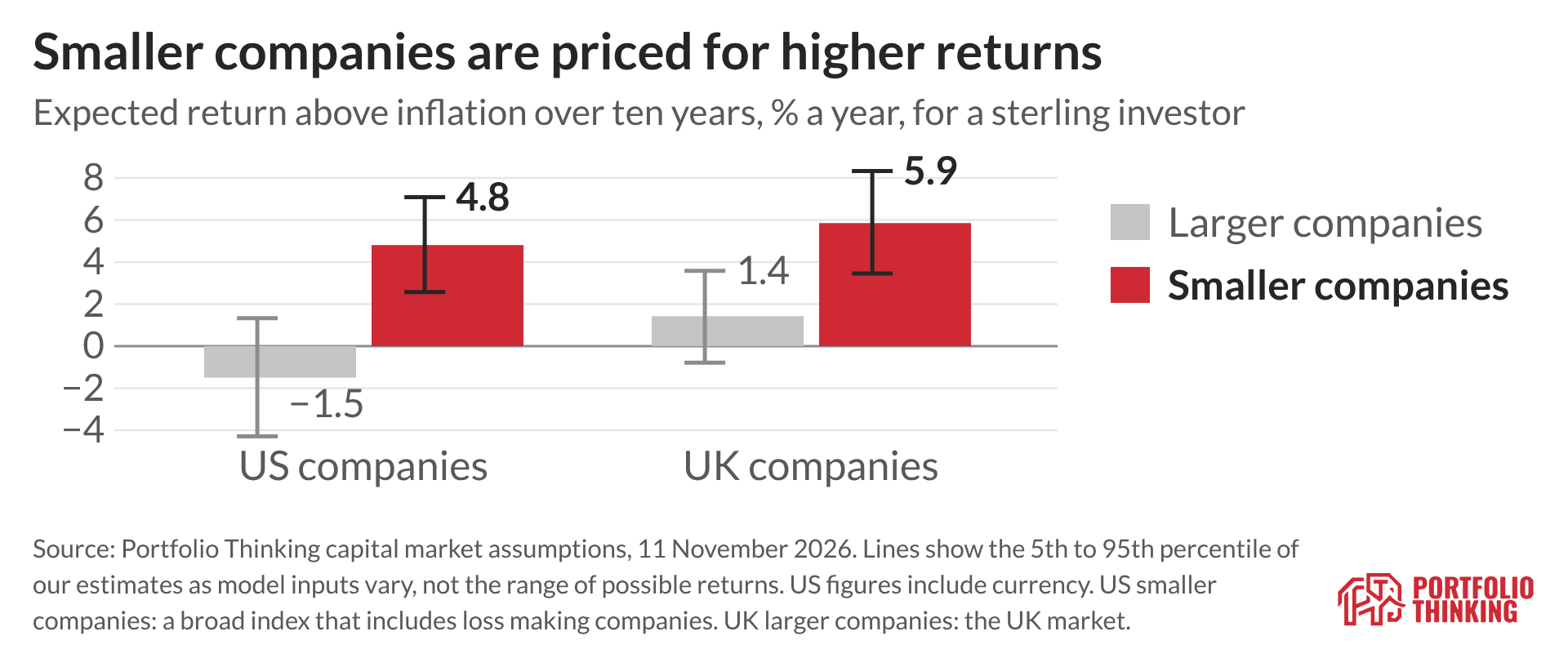
On our estimates, smaller companies could return about 5% a year above inflation in the US and 6% in the UK for a sterling investor over the next decade, against about 1.5% below inflation for larger US companies.
Key takeaway 3
Smaller companies have offered active managers better odds than the largest companies.
In our view, US smaller companies are among the most attractive options in today’s stock markets. This stands in sharp contrast to the largest US companies, which are priced to offer unusually low returns after a period of rapidly rising prices and unusually high profits. However, this opportunity is easily missed, as our attention is drawn to the largest and most newsworthy companies.
Under the Christmas tree, the biggest boxes draw the eye first, and we easily miss the smaller packages that are often of greater value.
On our estimates, smaller companies could return about 5% a year above inflation in the US and 6% in the UK over the next decade for a sterling investor, against about 1.5% below inflation for larger US companies. These are estimates, not forecasts.
A premium that arrives unevenly
Smaller companies are typically seen as more risky than their larger peers, as they often have shorter histories, can be harder to trade and must pay more to raise capital. Consequently, their share prices tend to be more volatile.
However, investors have usually been rewarded for bearing that extra risk. Smaller companies have beaten larger ones by close to 3% a year in the US since 1927 and in the UK since 1955, which is one reason many active managers have tended to hold more in them than indicated by their benchmark index.
These additional returns are not evenly distributed. As figure 2 shows, smaller US companies outpaced larger ones until the mid 2000s and broadly held that lead until 2018, before giving back much of it. In the UK, smaller companies led the wider market until 2021 and have since surrendered all of the lead they had built since 2009.
Over the short term, there is some evidence of a reversal: in the ten months to the end of October, smaller US companies returned about 18% in sterling, against 12% for larger ones. However, ten good months have barely dented a decade of lagging.
Why the largest companies pulled ahead
Part of the explanation is that many promising young companies no longer join the public exchanges. Increased investment in private equity and private credit funds has provided the capital a growing company needs, so it can remain private for longer.
The number of listed US companies has roughly halved since 1996, to about 3,900, and the typical company now lists at twelve to fourteen years old, against eight in the 1980s. Consequently, more of the fastest growth can happen before a company reaches the stock market and becomes available to most investors.
At the same time, money has flowed into index funds, which buy companies in proportion to their size. In the US, index funds overtook active funds at the end of 2023 and held 55% of long term fund assets two years later. Recent academic research finds that these flows lift the prices of the largest companies most.
Alongside this flow of capital, the largest companies also earned much of their gain, as profits grew rapidly through the pandemic and again with AI. On our estimates, the return larger US companies earn on their shareholders’ capital has risen from about 19% in the mid 2000s to more than 35%, and the ten largest now make up about 38% of the main index of larger US companies.
Such high profits are unlikely to be sustained, and so our return expectations are grounded upon a gradual return to normal levels of profitability.
Below their usual price
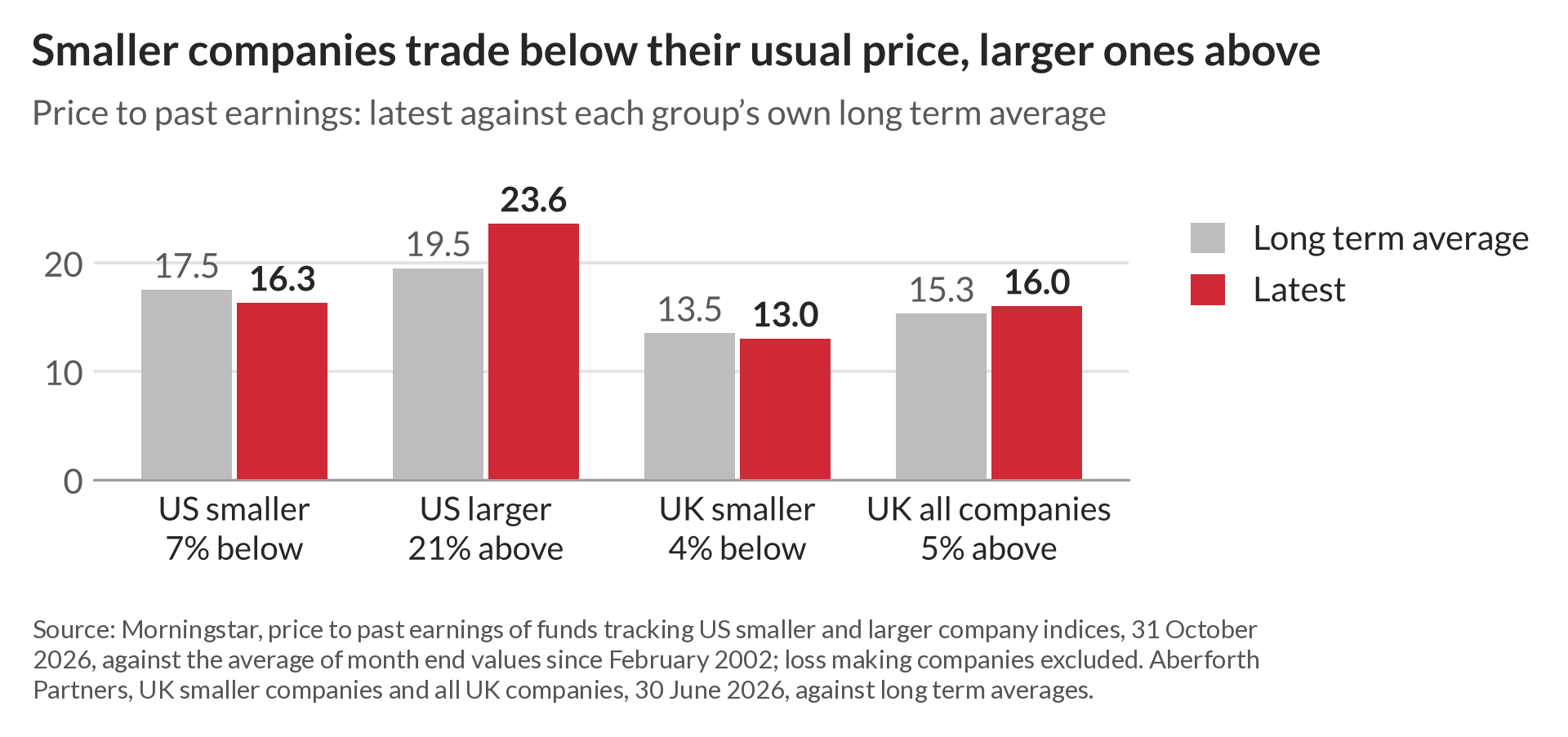
The result is an unusually wide gap between the valuations of smaller and larger companies, some of it potentially warranted, some of it not. However, smaller companies are not simply cheaper than the giants: they also trade a little below their own usual price, while larger companies trade well above theirs (figure 3). In the US, smaller companies are priced at about 16 times past earnings, against an average of 17.5 since 2002, and larger companies at about 24 times, against 19.5.
A low price is not always a bargain, but it is important to distinguish between what is scary and what is dangerous. The volatility of smaller companies can be uncomfortable, but it is the price of admission for a higher expected return. The danger lies in permanent loss of capital, which tends to be greatest among the two fifths of smaller US companies that make no profit.
The opportunity therefore lies in established, profitable businesses, many of them in traditional industries. They may never grow as quickly as the private companies that fill the headlines, but they do not need to. Our estimates assume earnings at smaller US companies grow more slowly than at larger ones, and still arrive at a higher return because the price paid for those earnings is lower. Consequently, that lower price also offers a margin of safety should growth disappoint.
Low prices attract buyers
Low prices also attract buyers with cash to spend, and larger companies and private equity firms have been bidding for listed companies throughout 2026. By late July there had been more than thirty bids for UK listed companies of all sizes this year, at an average premium of 43%. In the US, a string of smaller industrial companies has agreed to be bought, two of them at premiums above 25%. For their shareholders, a takeover can deliver in a single day the recovery in price that might otherwise take years.
Owning more than the index
Index funds have been one of the greatest developments in recent decades, supporting client outcomes at very low costs. However, a portfolio does not have to mirror a benchmark. An index fund holds smaller companies only in proportion to their size, which after a decade of lagging is small. Holding more in smaller companies than the index is a deliberate choice that requires discipline, as it means accepting periods, sometimes years, when the portfolio trails the index.
Smaller companies have also given active managers a better chance of adding value than the largest companies, partly because fewer analysts study them. More than half of smaller US companies are followed by five or fewer analysts, against 1% of the largest US companies. Over the ten years to June, 29% of active funds investing in smaller US companies survived and beat their index alternatives, against 13% among larger companies.
In our view, smaller companies are where active management is most likely to earn its fee, and where we favour it, provided managers are chosen with care: even here, most fail to beat an index alternative over ten years.
Valuation tells us more about direction than timing, and smaller companies could stay out of favour for some time yet. However, in our view investors are now being paid well to wait. Those prepared to do so should find that the best things really do come in small packages.
Three ideas for portfolios
General ideas for advisers to consider against each client’s objectives and circumstances; not personal recommendations.
- 1
Decide the weight, do not inherit it.
Index weights reflect today’s prices, and so the last decade’s returns, rather than any view on value. Consider whether smaller companies in the US and the UK deserve more than their index weight, sized so that the client can stay invested through a long period of lagging.
- 2
Beware unprofitable exposures.
Within smaller companies, consider established, profitable businesses rather than loss making ones. A broad index of smaller US companies holds many businesses that do not yet make a profit.
- 3
Use active managers where the odds are better.
Fewer analysts follow smaller companies, which leaves skilled managers more to find. Most still lag over ten years, so choose with care and judge them over a full market cycle.
For professional intermediaries only. This outlook reflects Portfolio Thinking's views at the time of writing and is not a forecast, a recommendation or personal advice. Expected returns are estimates, not guarantees; the value of investments can fall as well as rise.