
05 Private assets
Mind the Gap
Private assets can reward patient investors. However, a poor structure can turn a successful strategy into a disappointing investment.
5 min read · Portfolio Thinking Annual Outlook 2027
Key takeaway 1
In principle, private assets reflect good investing: a long horizon, significant ownership of businesses and freedom from the daily price movements that can tempt us into mistakes.
Key takeaway 2
In practice, fees, valuations set by the managers who are paid on them and liquidity promised on illiquid assets can consume that reward, as hedge fund investors discovered in 2008 and private credit investors have been reminded this year.
Key takeaway 3
Investors should set a clear expectation of returns rather than relying on past performance, understand what they own, avoid overpaying and commit only money they will not need.
Private assets have a role in some portfolios, but only when investors are properly rewarded for what they give up.
Sound principles, uncertain structures
In theory, owning private assets simply reflects sound investing principles: it is focused on the long term, allows investors to become significant owners of good businesses and is free from the daily price movements that can tempt us into costly mistakes.
However, a sound strategy does not guarantee a good investment, and the current popularity of these assets risks undermining their benefits. The situation is similar to that faced by commuters on the London Underground at peak hours, when the journey costs more, the carriages are uncomfortably crowded and it is easy to trip when entering and exiting a train. Those of us who use the Tube are constantly told to ‘mind the gap’, and investors considering private assets would benefit from a similar reminder.
The gap that matters lies between the expectations and the reality of investing in private assets, and it is seen most clearly in the difference between the liquidity a fund offers and the liquidity of what it owns. Illiquidity is not a flaw of private assets but the source of much of their reward, since investors have traditionally been offered higher returns in exchange for committing their money for longer.
Individual investors have typically been more reluctant to accept illiquidity, and consequently asset managers have sought to bridge the gap by creating products that appear to offer greater liquidity than their underlying assets. Investors have responded, and assets in US semiliquid funds, which offer to buy back a small part of their shares each quarter, approached $600 billion in March, more than double their level at the end of 2022. This enthusiasm has not been limited to the US. In the UK, Long Term Asset Funds can now be held in ISAs, and seventeen pension providers have pledged to place 10% of their default funds in private markets by 2030.
We have been here before
This is not the first time strategies promising superior returns, charging high fees and offering limited liquidity have captivated investors. After the technology bubble burst in 2000, investors sought higher and steadier returns from hedge funds, whose assets approached $2 trillion by the middle of 2008. Many reached them through funds of funds, which managed about half of the industry’s assets and charged, on average, a further 1.3% a year and 7% of profits on top of the underlying managers’ fees. Over the twenty years to 2010, funds of funds returned about 8.2% a year, against 12.2% for single manager funds.
In the scramble for the best managers, investors accepted lock ups and gates, while some funds of funds relied on new money and borrowing to bridge the liquidity gap. When the financial crisis arrived, the leverage in the underlying funds and in the structures above them was exposed.
The average fund of funds lost about 17% in 2008 and many suspended withdrawals. The strategies that survived later reached advisers and their clients rebadged as ‘liquid alternatives’, with lower fees, regular dealing and more established managers. In many cases it was the structure, rather than the strategy, that failed investors.
This year’s test
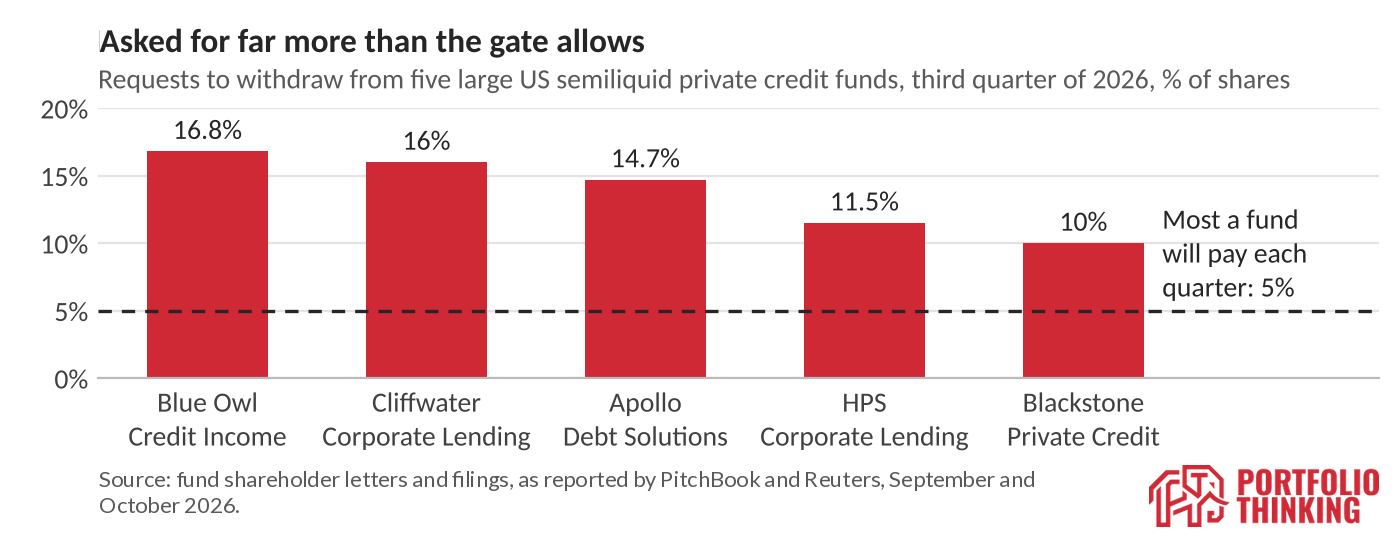
Private credit has provided this year’s reminder. Following concerns about lending to software companies early in the year, requests to withdraw from the largest US semiliquid private credit funds rose far above the 5% that most will pay each quarter (figure 1).
UK investors have seen gates for illiquid assets before. Open ended commercial property funds suspended dealing after the referendum in 2016 and again in 2020. Several were subsequently closed.
Preparing for the gate
Given the challenge of illiquidity, investors must have a clear expectation of returns before investing rather than simply relying on past performance, which flatters assets whose prices are set infrequently. That expectation should start from today’s yields and valuations and deduct likely losses and every layer of fees.
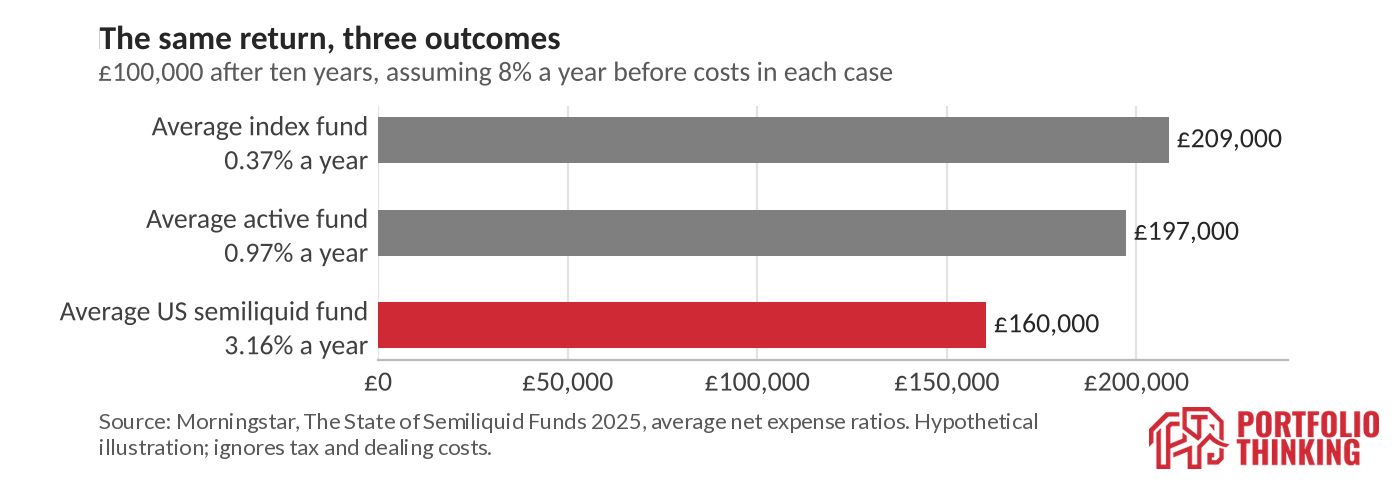
Costs matter more here than elsewhere. Morningstar found that the average US semiliquid fund charged about 3.2% a year, against 0.4% for the average index fund, and only four of the nineteen such funds it rated earned a positive rating of Bronze or Silver. On the same return before costs, that difference compounds into a very different outcome (figure 2).
Know what you own
Next, we need to understand the variety beneath the label. Private equity, venture capital, direct lending, infrastructure and property carry very different risks, and two funds with the same label can own very different assets.
Even within private credit, the quality of the underlying loans deserves close attention. Fitch’s measure of US private credit defaults reached a record 6.3% in the year to September. The credit ratings attached to such loans also require greater scrutiny, as many are private ratings that are neither published nor widely tested. A Columbia Business School study found that privately rated bonds held by US life insurers were more likely to suffer impairments than publicly rated bonds with the same rating.
Those insurers have become some of the largest buyers of private credit, sometimes from companies connected to them. Apollo originated about 73% of the invested assets of Athene, its US annuity business, at the end of 2025.
Who sets the price?
When investing, the price you pay for an asset is a key determinant of the future return. In private markets, that valuation is reported by managers rather than set by the market. The FCA’s 2025 review of private market valuations found few firms able to demonstrate clearly that valuation was independent of the managers whose fees depend on it.
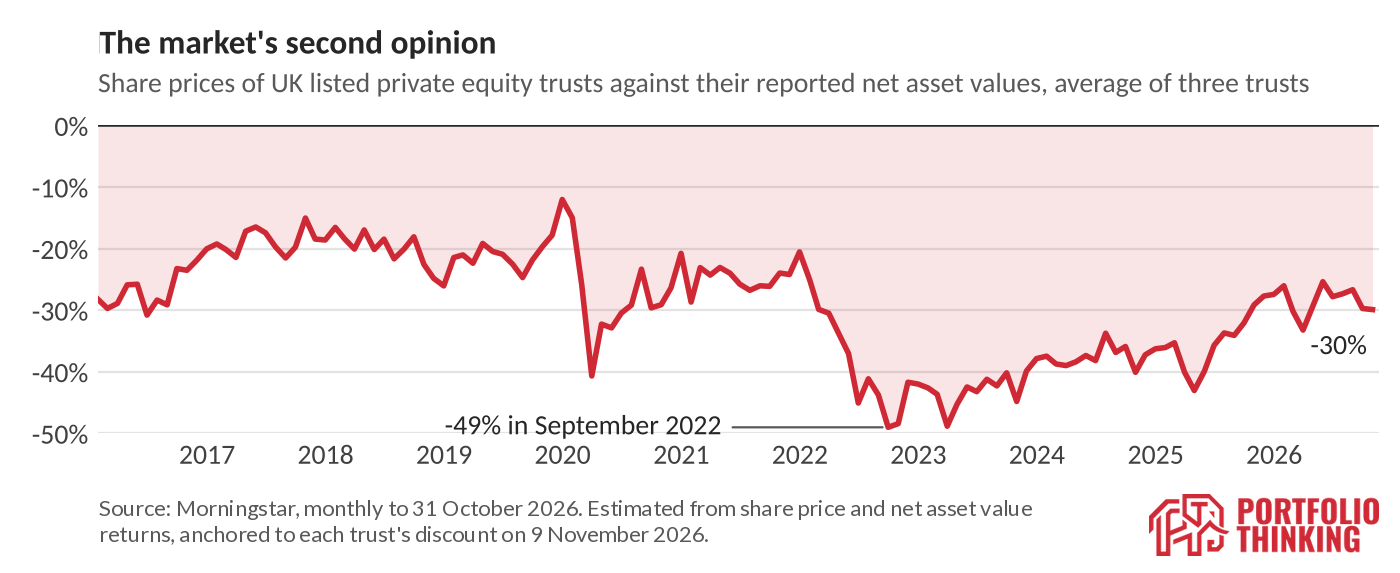
The listed market offers a second opinion. UK listed private equity trusts trade at an average of about 30% below their reported net asset values (figure 3), suggestive of some scepticism about those reported values. Investors in semiliquid funds are not given the opportunity to benefit from that discount but must buy and sell at net asset value.
Private markets reward patience, but they cannot manufacture liquidity. The time to mind the gate is before we walk through it.
Three ideas for portfolios
General ideas for advisers to consider against each client’s objectives and circumstances; not personal recommendations.
- 1
Know every layer of cost.
Private asset funds can carry management and performance fees, the costs of buying, financing and running the underlying assets, and platform or wrapper charges, and some of these are taken inside the fund rather than shown in its headline charge. Ask for all of them, and for how they would affect returns in good years and bad. Invest only where the expected return after every charge is more attractive than that of an equivalent public market fund.
- 2
Size for the gate.
Treat private assets as money that may be out of reach for several years, and hold enough in liquid assets to meet withdrawals, rebalancing and unexpected needs without relying on a fund’s quarterly dealing.
- 3
Consider the listed route alongside the semiliquid one.
Private equity investment trusts have no gate and publish a market price, which currently sits at a discount to their reported values. That price can be volatile, and discounts can widen as well as narrow.
For professional intermediaries only. This outlook reflects Portfolio Thinking's views at the time of writing and is not a forecast, a recommendation or personal advice. Expected returns are estimates, not guarantees; the value of investments can fall as well as rise.