
06 Geopolitics
Built for Rougher Roads
After a decade that rewarded portfolios tuned for a single market environment, today’s uncertainty calls for portfolios built to cope with many.
5 min read · Portfolio Thinking Annual Outlook 2027
Key takeaway 1
Despite a decade of political and economic shocks, shares in developed markets returned about 13% a year in sterling, rewarding those who stayed invested.
Key takeaway 2
That success encouraged portfolios tuned for a single future, one that relied on government bonds rising when shares fell. Since inflation returned in 2022, gilts and shares have tended to move together.
Key takeaway 3
The answer is not to try to ‘time’ markets but to build more robust portfolios: stress tested, made from high quality components, and owned by clients prepared for a steadier journey.
In our view, the best response to the current environment is not to predict the next shock, but to build portfolios that can cope with a range of possible futures. A portfolio optimised for a single outcome is like a Formula One car that is built to go very quickly around a smooth and predictable track but is ill suited to a country road. For that journey we are better off in an SUV, slower in a straight line but far more robust when the surface is uneven and the conditions uncertain.
A decade of surprises
We have experienced a decade of extraordinary and often surprising change: the Brexit vote and Donald Trump’s first election victory, the rise of populism at both ends of the political spectrum, a pandemic, war in Europe and unpredictable trade conditions. This year brought an attack on Iran, the closure of the Strait of Hormuz and, most recently, a change in control of the US Congress at the midterm elections.
Rewarded for staying invested
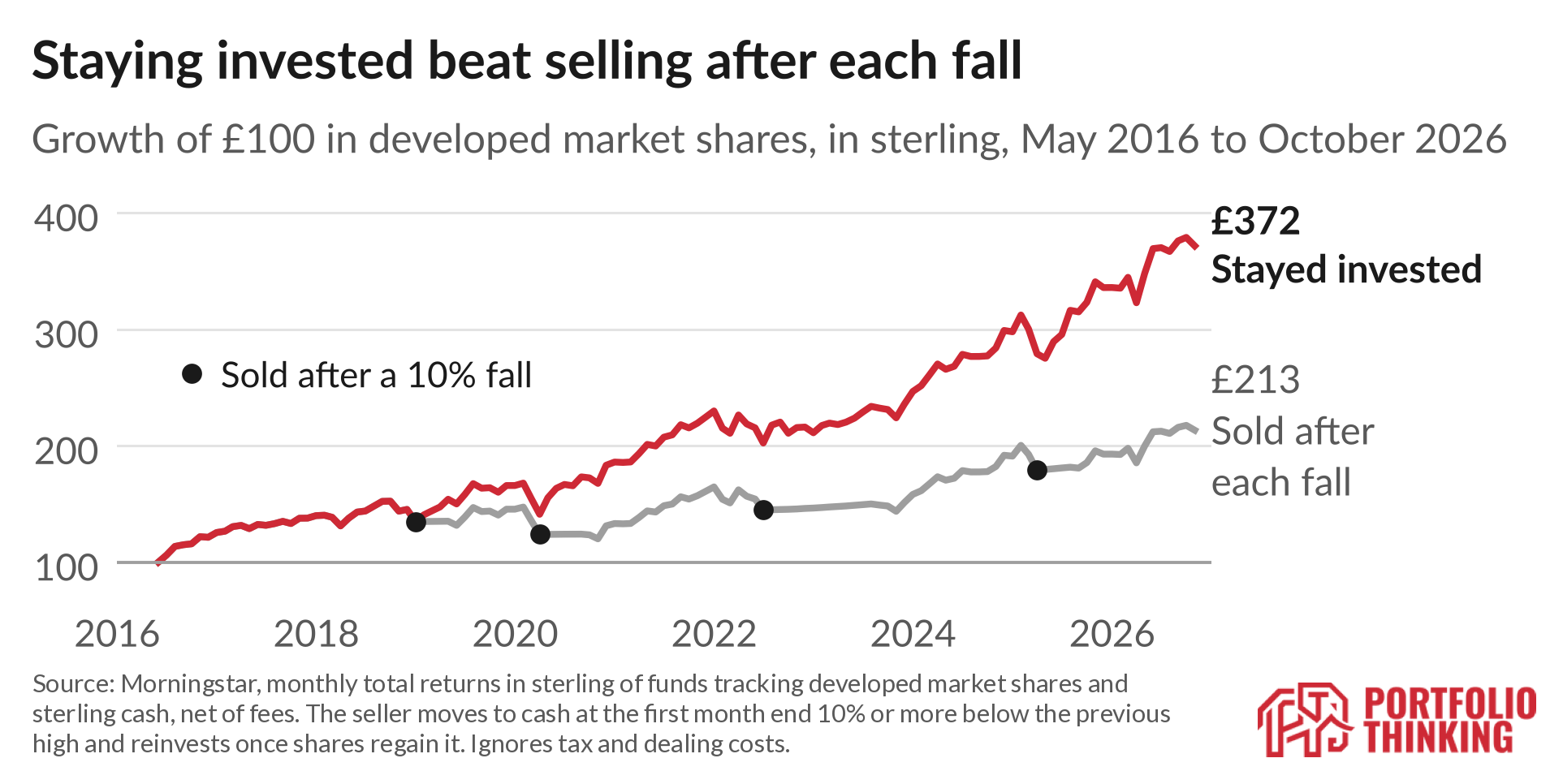
Over the same decade, stock markets have made solid progress. In sterling, £100 invested in shares of developed markets in May 2016 would have grown to about £372 by the end of October. Each time markets stumbled, investors who held their nerve, or added to their portfolios, were swiftly rewarded: the losses of the pandemic were recovered within five months of the low, and those of last year’s tariff shock within three. By contrast, as figure 1 shows, an investor who sold after each fall of 10% or more, and reinvested only once shares had regained their previous high, would have ended with about £213.
Consequently, shares now make up a much larger part of investors’ wealth. US households hold close to half of their financial assets in shares, the highest proportion in Federal Reserve data that go back to 1945.
We are often reminded that it is time in the market, not timing the market, that matters. This reflects both the power of good businesses to grow over time and our tendency to buy and sell at the wrong moments. Morningstar’s Mind the Gap study estimates that over the ten years to 2025 the average dollar invested in US funds earned 1.2 percentage points a year less than the funds themselves, because of the timing of investors’ purchases and sales. Frequent trading also adds costs and tax.
Tuned for one track
This long run of success encouraged many investment managers to optimise their portfolios, tracking more closely the indices that led the market and making full use of their risk budgets. That approach worked well while the track was smooth, but it relied on government bonds rising when shares fell, rapid recoveries and steadily rising profits. The first of these failed in 2022, when inflation pushed interest rates and bond yields higher and gilts fell alongside shares. Importantly, government bonds tend to protect against market and economic contractions rather than inflation.
Protecting against a rougher road ahead
Some prominent investors, such as Ray Dalio, argue that the world order established after 1945 has broken down. Although this may make for fascinating (and sometimes frightening) conversation around the dinner table, it has a deeper relevance for investors.
A new geopolitical environment could disrupt the steady progress we have enjoyed for most of our investing lives. We caught a glimpse of it after the pandemic, when companies rushed to shorten supply chains and bring operations closer to home. Such resilience comes at a cost and may mean slower growth and thinner profit margins, while greater spending on defence could lead to higher taxes.
How do we prepare for this without trying to time the markets? In our view, the answer is to build more robust portfolios.
Test the vehicle before the journey
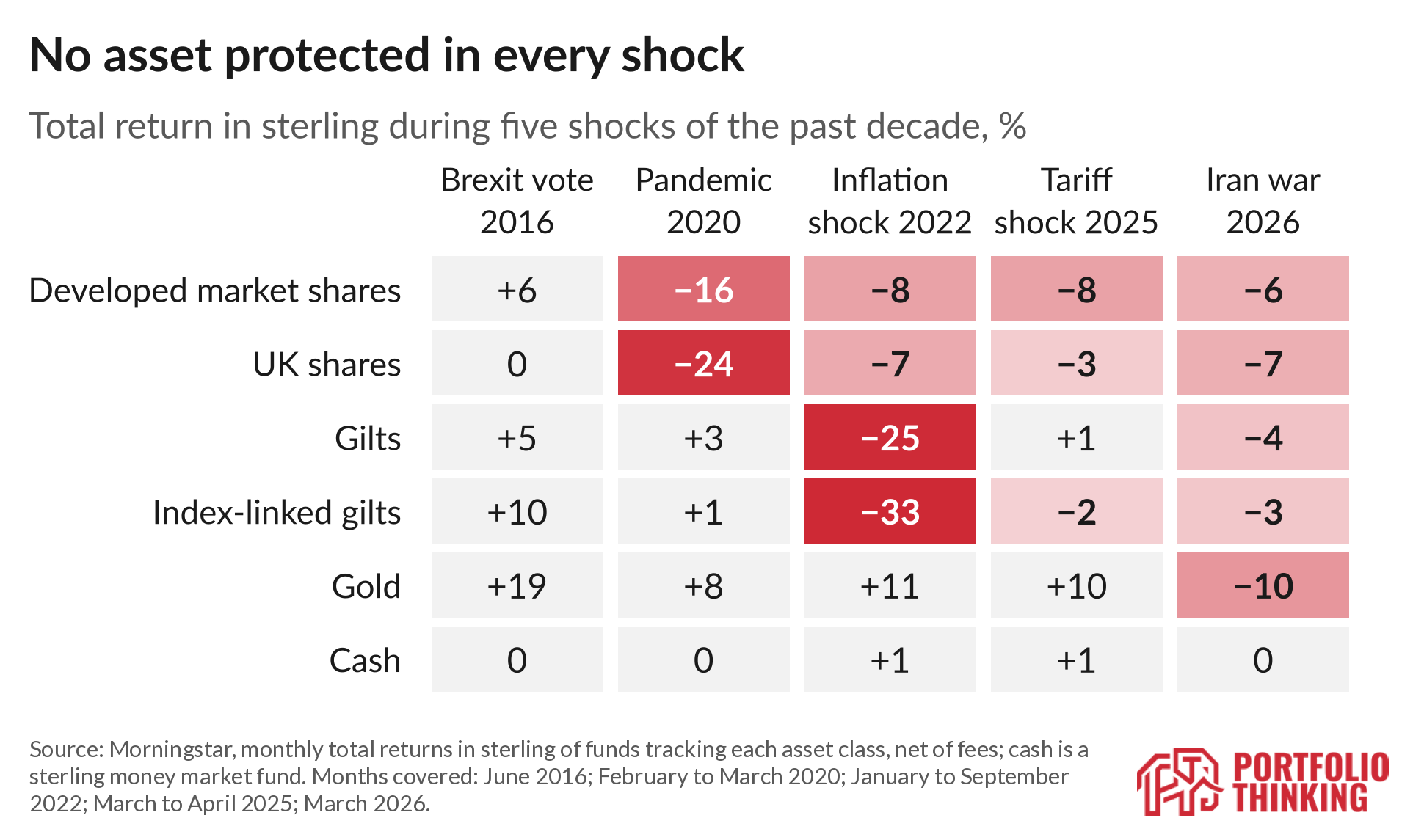
To build an SUV portfolio, we need to consider returns across a range of environments, and the best way to do this is to stress test candidate portfolios against a variety of positive and negative events, so that we find the potholes before the portfolio does. Figure 2 shows why.
In the five shocks of the past decade, no single asset protected a portfolio every time: gilts rose during the pandemic but fell by a quarter in the inflation shock of 2022, and gold rose in four of the shocks but fell by a tenth in March this year.
Testing candidate portfolios against a range of historical and possible scenarios (we use more than forty) exposes vulnerabilities that may not be obvious from a portfolio’s exposures alone, because it reveals interactions and fault lines that matter more in some scenarios than in others. Through an iterative approach, we can then reduce these risks, or accept those that are both unlikely and of limited impact.
Better components
Next, we need components of the highest quality, since poorly made parts weaken a vehicle however well it is assembled. An SUV also needs differently engineered parts from a Formula One car, so we may need more flexible mandates and potentially a portfolio that looks less like the index. That requires deep research, and a way to compare expected returns and risks on a consistent basis, which is why a comprehensive set of capital market assumptions, anchored to today’s prices, should sit at the heart of your approach.
Preparing the passengers
Finally, we must prepare ourselves and our clients for the journey. A passenger used to travelling rapidly around a smooth and predictable track will find an SUV on a country road uncomfortable, and the pace slower than they are used to. However, for most investors the real risk is not a slower journey but failing to reach their destination at all. If, as seems possible, we are entering a more difficult environment, reaching our goals will matter more than the pace at which we set off.
We cannot choose the road ahead, but we can choose the vehicle.
Three ideas for portfolios
General ideas for advisers to consider against each client’s objectives and circumstances; not personal recommendations.
- 1
Stress test before you build.
Run your portfolios through a range of past and plausible shocks, including growth, inflation and currency shocks, and decide which vulnerabilities to reduce and which to accept because they are unlikely or of limited impact.
- 2
Diversify the protection, not just the assets.
No asset protected a portfolio in every shock of the past decade. Consider combining government bonds, which have tended to help in slowdowns, with exposures that have behaved differently in other shocks, such as alternatives, sized so that no single one dominates. These can be volatile in their own right.
- 3
Set expectations before the road gets rough.
Explain to clients that a robust portfolio may lag the index when markets are strong, and agree in advance how and when it will be rebalanced.
For professional intermediaries only. This outlook reflects Portfolio Thinking's views at the time of writing and is not a forecast, a recommendation or personal advice. Expected returns are estimates, not guarantees; the value of investments can fall as well as rise.