02 Artificial intelligence
Artificially Inflated?
AI will change the economy. The question for investors is how much of that change today’s prices already assume.
5 min read · Portfolio Thinking Annual Outlook 2027
Key takeaway 1
Record spending, borrowed money and circular finance lead many to ask whether AI is really an abbreviation of ‘artificially inflated’. That is the wrong question.
Key takeaway 2
The better question is how much your portfolio depends on these companies, and what today’s prices already assume about them.
Key takeaway 3
Rather than commit to one narrative, investors need to think in probabilities about the future of AI and the companies developing it.
Artificial intelligence is changing how businesses operate and how much land, power and water the economy needs. We have little doubt that it will reshape the economy. Whether it rewards investors at today’s prices is a different matter.
It is easy to see why many now ask whether AI is artificially inflated. The largest cloud computing companies are expected to spend about $800bn this year, almost twice last year’s total. Businesses that generated cash for years are now raising it. The largest cloud computing companies issued more than $200bn of investment grade bonds by early October, and Alphabet has announced an $80bn share issue. Newer AI companies increasingly rely on circular finance, in which chipmakers invest in or underwrite the customers that buy their chips.
Yet whether AI is artificially inflated is the wrong question. It invites us to adopt a comfortable narrative and to make predictions with misplaced confidence. The important questions are how much our portfolios depend on these companies, and what today’s prices already assume.
Every boom builds too much
This is not the first technology to transform the economy. Railways, electricity, semiconductors and the internet all did. In each case, enthusiasm about long term demand led to too much investment too soon.
By 1850, investment in Britain’s railway mania totalled almost half of a year’s national income. In 2002, only 2% to 5% of the fibre optic cable laid in America during the internet boom was in use.
The surplus was eventually absorbed, either because demand grew to match it or because the excess capacity was destroyed. Either way, much of the capital invested was lost, through operating losses or the burden of debt. Shareholders in telecoms companies alone lost about $2tn of market value after 2000.
Whether the cycle repeats for AI is a fascinating debate. It matters because many of us already have substantial investments in these businesses.
The index has made its choice
Because demand for AI has grown much faster than the economy, AI companies have driven much of the recent return. On our estimates, thirteen AI linked companies contributed about 60% of the return from US large companies, in dollars, between November 2022 and August 2026. In emerging markets, TSMC alone contributed 20 percentage points of the 69% return over the same period.
As a result, AI companies now make up about 40% of both the US market and emerging markets, so owning either index has become a large bet on one theme. Adding emerging markets therefore no longer diversifies a portfolio as it once did.
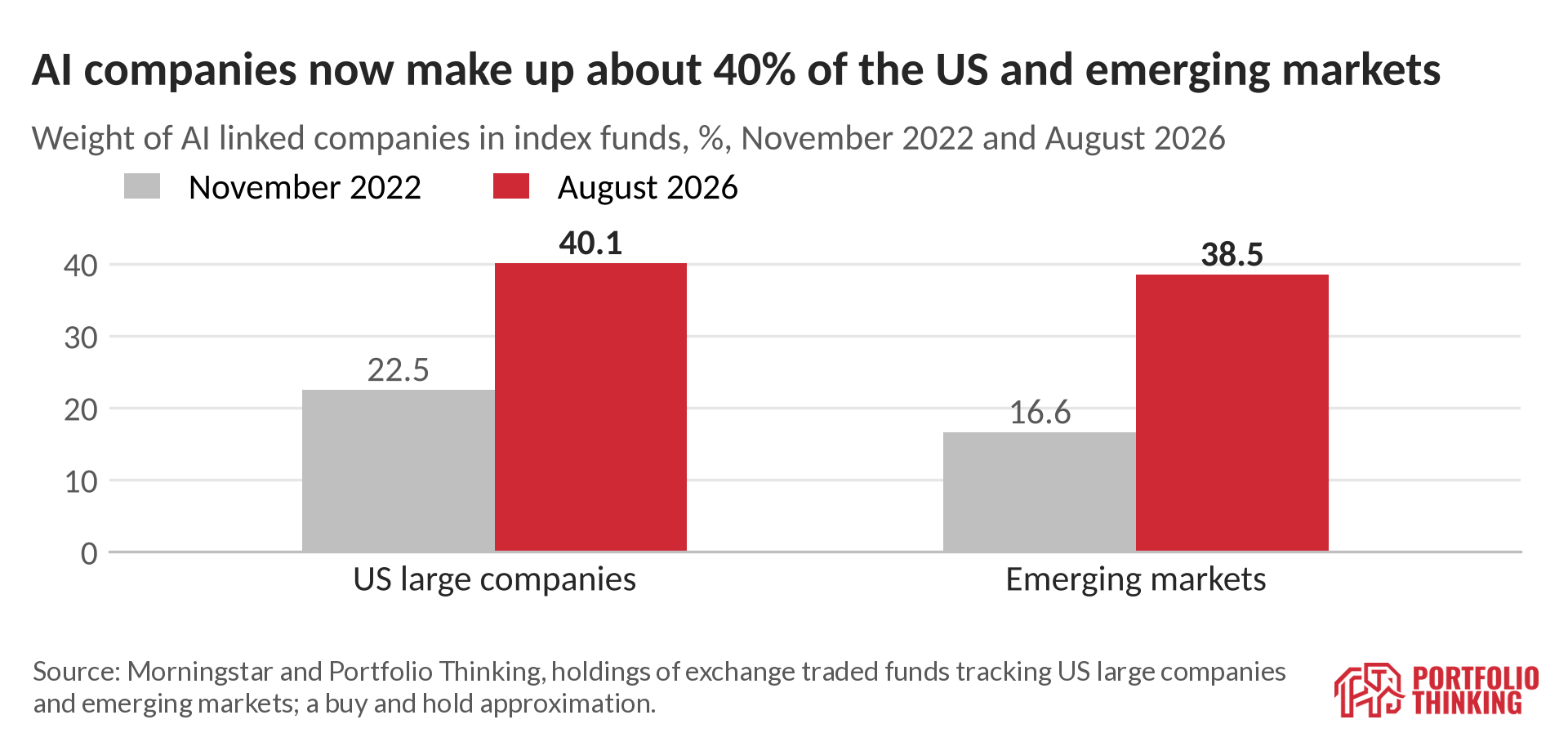
The concentration is still growing. SpaceX became a public company in June and joined a widely followed US index within a month. Anthropic, the maker of Claude, filed to list in October, and OpenAI, which makes ChatGPT, has said it expects to follow. Each new listing adds to the exposure of index investors.
Spending for leadership
Listing also gives these companies access to capital, which the industry needs. They are investing heavily because they expect leadership in AI to bring the outsized profits that search (Alphabet), cloud computing (Amazon), smartphones (Apple), office software (Microsoft) and social media (Meta) brought before.
Predicting a collapse would be easy, but the people running these businesses are not naive, and many have much of their own wealth tied up in them. They are unlikely to pursue an unprofitable race indefinitely, and the pace is already being tested. In October, Microsoft trimmed its spending forecast for this year, citing capacity delays, and OpenAI cut its fundraising target by a third.
Less spending would turn most of the leaders back into highly cash generative businesses. It would be harder on the chipmakers that supply them, and on newer companies with no established profits to fall back on, where capital could be lost for good.
A price like a combination lock
Good businesses are not always good investments. The returns investors receive depend both on the businesses and on the price paid for their shares, and today’s prices already assume substantial growth in AI.
When SpaceX listed, our analysis found that its price needed a chain of hopeful assumptions to come good at once. Our work on Anthropic’s filing suggests that even its last private valuation, about $1tn, requires revenue to grow by about 26% a year for a decade, and the company to win about 35% of a $2tn market for AI by 2036. Valuations this high behave like a combination lock: getting most of the numbers right is not enough to unlock attractive returns.
The established leaders face a bind. Cutting their spending would restore their cash flow but leave them relying on existing businesses that grow more slowly, and slower growth commands lower prices. Prices could therefore fall a long way if growth disappoints.
Our capital market assumptions allow for profitability and valuations to return towards normal levels. On that basis, US shares would return about 1.5% a year less than inflation for a sterling investor over the next decade. That is an estimate, not a forecast.
A better question
Successful investors weigh a range of possible outcomes rather than anchor on one narrative. A simple way to do this is a grid built on two questions: will AI grow faster or slower than prices assume, and will the economy grow or slow?
The important question is not whether AI will keep growing or deflate, but how your portfolio would fare in each future, and whether it depends too heavily on one of them. A portfolio that simply follows the index has become, without anyone deciding, a bet on the top left corner.
Three ideas for portfolios
General ideas for advisers to consider against each client’s objectives and circumstances; not personal recommendations.
- 1
Measure the exposure, not the label.
Look through US, global, emerging market and technology holdings to the combined weight in AI linked companies. It is often larger than intended.
- 2
Test the portfolio against all four futures.
Agree with each client how success is measured, against a benchmark or in absolute terms, then check how the portfolio would fare in each quadrant, starting with its weakest.
- 3
Consider what depends less on AI.
Smaller companies, developed markets outside the US and high quality government bonds depend far less on AI. On our estimates, the first two are priced for higher returns.
For professional intermediaries only. This outlook reflects Portfolio Thinking's views at the time of writing and is not a forecast, a recommendation or personal advice. Expected returns are estimates, not guarantees; the value of investments can fall as well as rise.