
01 Capital market assumptions
Signposts, Not Satnav
Capital market assumptions point the way.
5 min read · Portfolio Thinking Annual Outlook 2027
Key takeaway 1
Capital market assumptions are signposts, not a satnav. They point in a direction and may change at the next junction, but they cannot tell us the route or when we will arrive.
Key takeaway 2
Small differences between expected returns are usually noise. The ranking of assets, and the range of outcomes behind each estimate, matter far more than any single number.
Key takeaway 3
As gilt yields have risen, the reward for taking risk has shrunk. On our estimates, gilts are priced to return more than most major stock markets over the next decade.
Capital market assumptions are one of the most useful and most frequently misused tools available to investors. A long term return estimate for each asset is essential to understanding the likelihood of reaching an investor’s goals. They can also help identify attractive opportunities and mitigate the greatest risks.
Used well, they act like signposts on a journey. They point the way but tell us little about the road ahead: its bends, its hills or how long it will take. They are not a satnav, and they will not steer us around every traffic jam. As the journey continues and we reach the next junction, the signposts may point in a different direction.
We can ignore them, but the journey is likely to be more difficult. Following them will not remove the surprises along the way, but it should reduce them.
How our signposts are made
There are many coherent ways to build capital market assumptions, and they can reach quite different answers. Consequently, what matters most for those who use them is to understand how they are built and how they are meant to be used.
Ours assume that asset prices are more likely to return towards their long term average levels than for today’s anomalies to persist. They further assume that earnings growth, profit margins and the return companies earn on their shareholders’ capital also return towards their long term averages.
This has a sound history as a starting point for investing, since unusually high profits tend to attract competition and unusually low ones tend to force change. However, reversion is our starting point rather than a law. Where a market has changed structurally, the averages of the past are a poorer guide. Japan is a recent example. Governance reforms have pushed companies to return more cash to shareholders and, consequently, the returns they earn on their capital are rising relative to history. In such situations, the basic estimate can be improved through careful research.
Reversion also carries a high degree of uncertainty and is unlikely to happen quickly. Profits and valuations can stay far from their averages for many years, which is why a ten year estimate describes a direction rather than a destination.
The danger of false precision
Having invested considerable time and resources in building capital market assumptions, we face a persistent danger of becoming overconfident in the numbers and too focused on small differences between them. Unchecked, this can lead us to make decisions with more conviction than the evidence justifies.
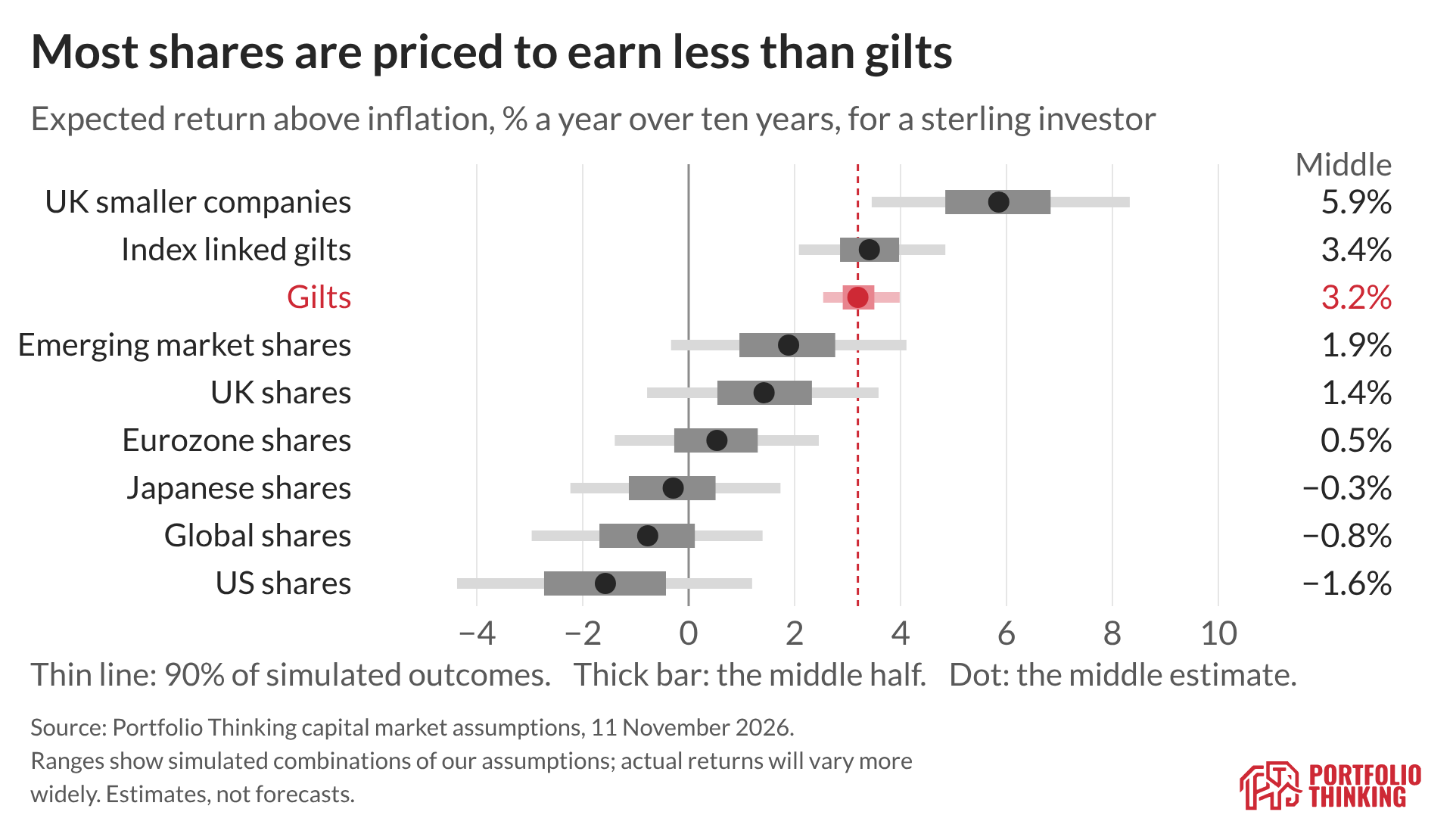
For this reason, we publish our capital market assumptions as a range of possible outcomes rather than a single average. For each asset we run thousands of simulations that vary the assumptions behind the estimate, such as how far profits fall back and how quickly prices adjust. Figure 1 shows the results. These ranges reflect uncertainty about our assumptions alone, so actual returns will vary more widely still.
By comparing the ranges, we can see where our expectations for two similar assets differ, and where the outcomes overlap so much that we can have little confidence in telling them apart. As figure 2 shows, UK and French shares are almost indistinguishable on our estimates, while UK shares stand clearly apart from US shares.
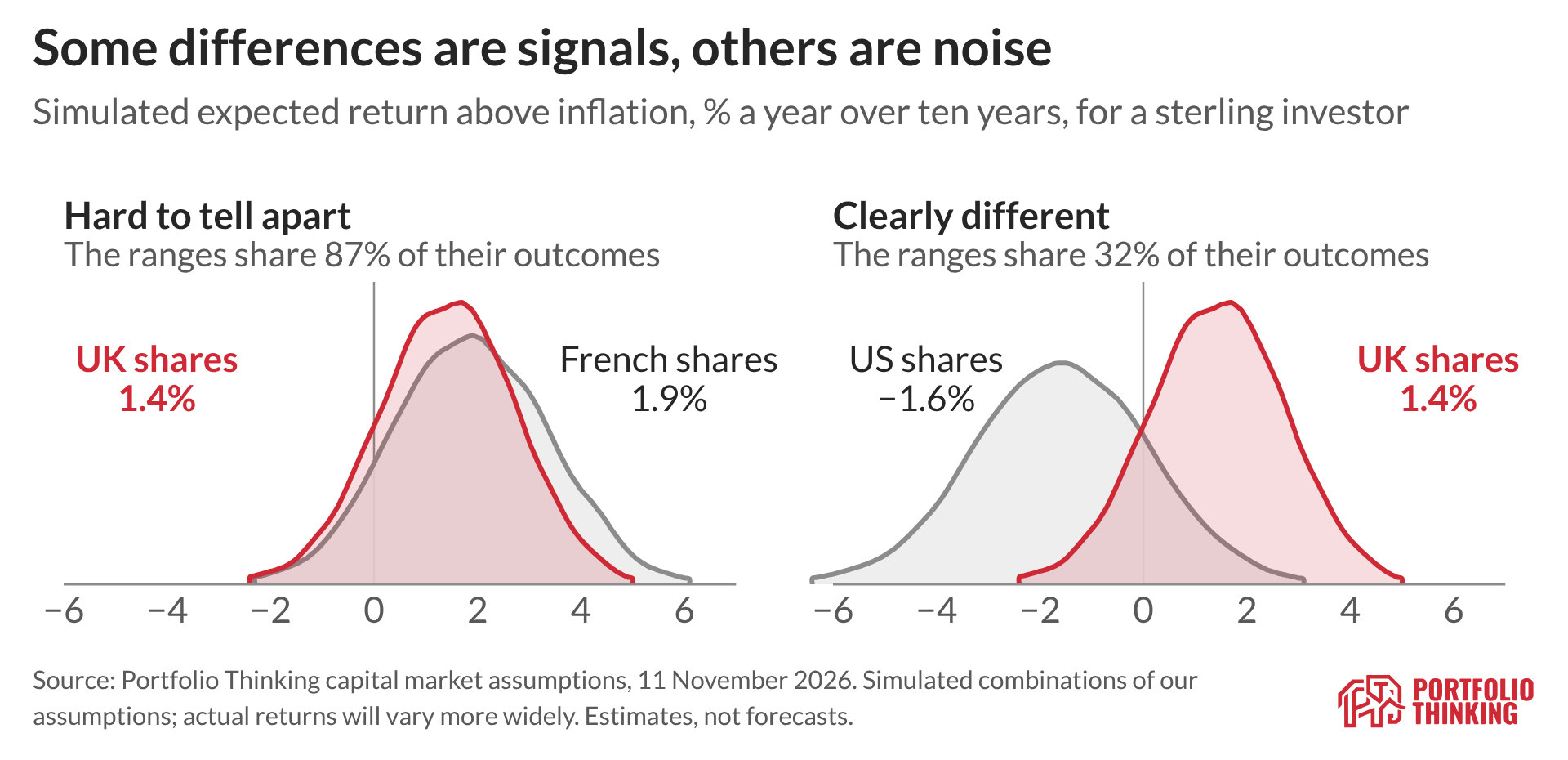
The ranking of assets by attractiveness is therefore far more important than any single estimate, because actual returns will be driven by a wide range of unpredictable factors. It also helps to be clear about the correct use of each tool. The purpose of the suitability process is to find the right level of risk for each client. Capital market assumptions help populate the portfolio once that level is set, and give a broad sense of whether markets are rewarding investors for taking risk.
Is risk being rewarded?
One way to judge this is to compare the expected return on shares with that on assets with a defined return such as government bonds held to maturity. Accepting the additional risk of owning equities should be rewarded with a higher expected return when both are measured on consistent assumptions.
As gilt yields have risen, the environment for taking risk has worsened. On our estimates, gilts are priced to return about 3.2% a year above inflation over the next decade, more than UK shares and far more than global shares. Even the most favourable 5% of our simulations for global shares fall short of the least favourable 5% for gilts. This is not a reason to abandon shares, since the right level of risk is set by each client’s goals, but it is a reason to be selective about where that risk is taken.
Reading the road ahead
US artificial intelligence companies illustrate the point. Since the launch of ChatGPT almost four years ago, they have both delivered very high growth and attracted very high valuations. Those valuations depend on that growth being sustained, which, in turn, depends on the continued building of AI infrastructure such as data centres.
The recent midterm elections showed how quickly that can be questioned. New governors in Texas, Georgia and Ohio, three of the busiest states for data centre construction, have called for pauses on new development. The risk to the buildout reduces the growth expectations of chipmakers and of the newer companies that rent out computing power, while improving the prospects of the largest cloud companies, which have been investing an extraordinary share of their cash flow in AI. Shares in the newer companies fell, while those of the largest cloud companies rose.
While we are not able to predict every twist and turn of the AI journey, we know that today’s share prices assume it will be an easy one. This leaves little room for improvement and plenty of space for disappointment.
The reverse is also true. Unloved companies, priced as though their earnings will stay low, can offer very attractive returns. There is almost always a reason to be negative about them, but the probability that everything goes wrong is low, and so they can be attractive destinations for capital. The UK is a good example. Its mid sized and smaller companies have been out of favour for years, yet on our estimates they offer about 6% a year above inflation over the next decade, nearly twice what gilts offer.
A signpost cannot show us every bend in the road, but it can stop us heading the wrong way.
Three ideas for portfolios
General ideas for advisers to consider against each client’s objectives and circumstances; not personal recommendations.
- 1
Set the risk, then fill it.
Agree each client’s level of risk through the suitability process first, then use capital market assumptions to decide where that risk is best taken.
- 2
Act on clear differences, not small ones.
Where the ranges for two assets overlap heavily, let cost, diversification and the client’s circumstances decide instead.
- 3
Ask to be paid for risk.
Compare what each riskier asset is priced to return with what gilts offer on consistent assumptions. Where the extra reward is thin, consider whether the risk is needed to meet the client’s goals.
For professional intermediaries only. This outlook reflects Portfolio Thinking's views at the time of writing and is not a forecast, a recommendation or personal advice. Expected returns are estimates, not guarantees; the value of investments can fall as well as rise.